The Bell-Shaped Curve and Similarity
Introduction
It is certainly no revelation that people judge each other by similarity to themselves. Not only or merely that, but we also compete with each other on our similarity to images of “ideal” supplied by the society we live in. We profile people on whether or to what degree they “fit” generally into the group of people we consider ourselves a part of. There is at all times an evaluation by each individual of exactly how similar they are to the people around them and to the image of ideal as they understand it.
This key behaviour and our habit of indoctrinating our children in it is a central motivating factor in our politics at every level, our education systems, and our penal systems. It influences social concerns such as bullying, and business concerns such has hiring and talent management, not to mention leadership. It is a pivotal aspect of control in society. The failure is in recognizing and debating the behaviour; the behaviour is profiling each other on similarity.
As I've detailed elsewhere (“On Watches and Scary People” in myebook) there is an assessment of threat bound into this profile of similarity that seems to be at the root of some very disturbing and even predatory behaviours. The incidences of spree murders at schools that seem to mask systematic persecution. The incidences of cold-blooded murders or assaults and rapes while people stood by and watched or even filmed it only to post the video online. In these cases, no insistence on outside influences, nor pretences of aberrant criminal behaviour can hide us from the troubling truth that it is our behaviour. We may not own the individual behaviours as a society (or we would all be criminals) but these are our people doing these things. Their behaviour is still representative.
However, even as we admit to our own faults, it would be grossly inaccurate to simply shoulder the blame for all injustice, as a group, culture, society, without trying to understand how we got there. I believe that looking at it and talking about it will free us from perpetuating the problems.
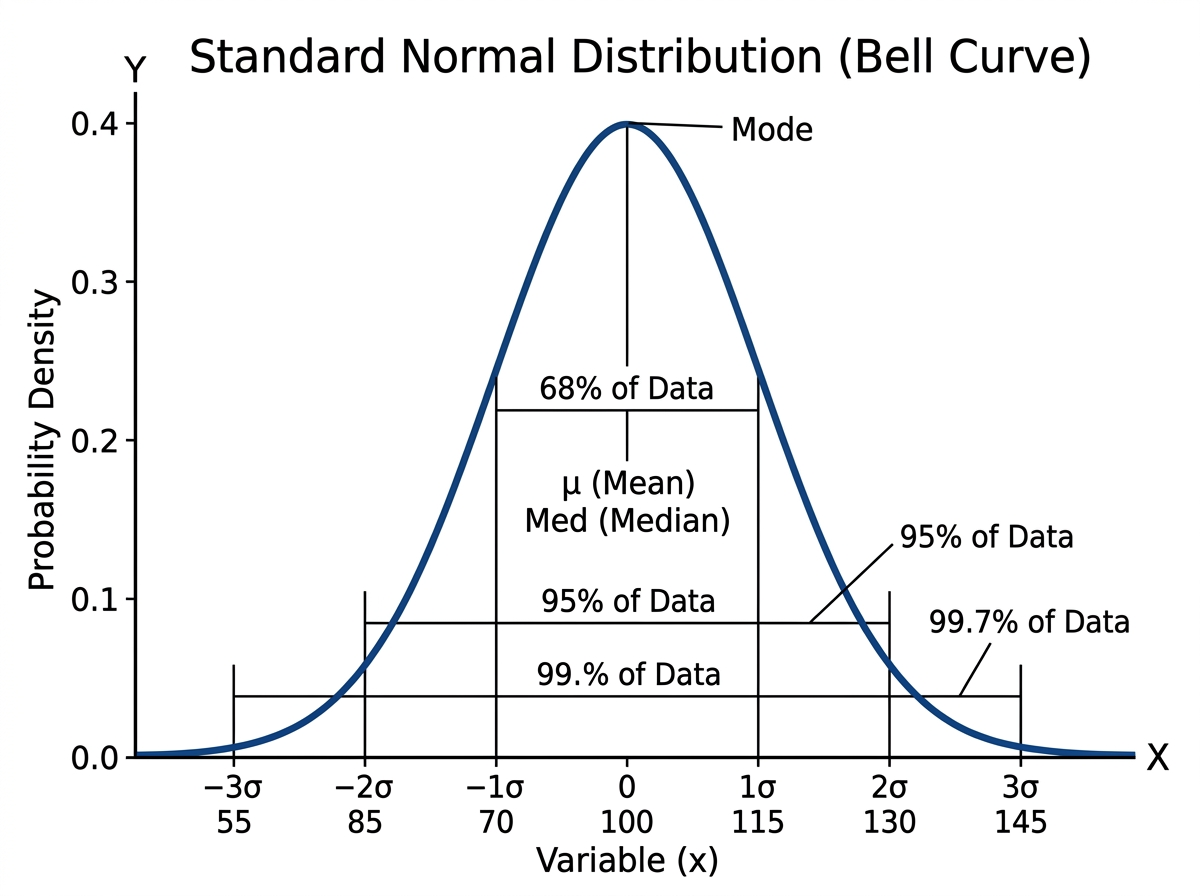
The standard bell-shaped curve used to define a distribution of IQ scores
The Divisions
This graphic is a bell curve representing the standard distribution of IQs. It also displays the typical relationship between success and IQ. It describes how IQ is a valuable asset, up to the point at which it no longer helps an individual become successful. But think about it now: We are talking about intelligence. What does it say about a society in which higher intelligence does not contribute to success, or is actually harmful to it? It seems as though we may be avoiding something because in the real world we don't measure IQ overtly, but instead estimate each others' social skill to decide whether we will have any kind of relationship with them. We are deciding who belongs and who does not.
Most people have heard that those who are super smart are also socially awkward. You can even see it on tv. On “Criminal Minds” Dr. Spencer Reid plays out that part for us very well. It's validating to think that social awkwardness is the reason for the the upper section on that curve.
Except that Dr Spencer Reid is a fictional character. He may indeed conform brilliantly to reality in his awkward, egg-head way, but there is no escaping the simple fact that it is our society that raises a roughly 16% portion of awkward egg-head children. It is understood that the lower 16% are incapable of great social skill, but the same cannot be said for the upper 16%. To simply put it down as a genetic predisposition to social awkwardness (I can almost hear somebody whispering it to themselves out there) is misleading. Say what you want but the Spencer Reids of reality grew up in the same society we did. It simply does not follow that greater intelligence somehow interferes with social skill development.
The very term “social awkwardness” is quite descriptive, but at the same time betrays how vaguely we think about and discuss it. It is a “social” thing, implying at the very least that that there is a group. If there is a group, then there is some assessment of belonging, as with any group of humans. And there is awkwardness which, by virtue of describing a particular person, attaches culpability to that person rather than the group. It is assumed that the individual will mold their behaviour to the expectations of the group. The term describes the primacy of group approval and the failure of the individual to belong according to the criteria. The term points out someone who does not belong.
Looked at that way, two things come of it. First is just the outline of the 68% in opposition to the 32%, and second is the judgement criteria summed up in a vague sentiment, “They just don't get it.”, which is to say that their communication skills are betraying their non-membership. In the upper 16% the awkwardness is a citation of betrayed expectations. If you don't obviously look different, then it is expected that you also communicate on the same level as the group. If you don't then there is a failure to manage the basic expectations of group membership.
At best, nobody in your group cares in the slightest how well you manage those expectations because they are flexible enough to accommodate differences. At worst, people are losing their heads over what amounts to pretty mundane behaviour. I'm not sure we need to go through a list, but if we started with bullying, I'm sure we can agree that it just goes down hill from there. It is an ugly scene. And in cases such as Rena Virk, or Seung Hui Cho, we have no behaviours to point at other than the utterly un-compelling rationale of social awkwardness.
Putting aside cold-blooded murder and systematic persecution, however, it turns out that such a vague assessment as social awkwardness may be roughly accurate after all. Research has long since shown that people with depression, and people with more serious personality disorders often seek validation of their negative personal assessments from others by soliciting negative responses. In other cases it is just as the term awkwardness implies, the person is not adhering to a natural give and take interaction in which both parties are validated for doing so. They really are in effect betraying the expectations of others, and that puts people “off”.
Even so, that changes little with regard to how society deals with what amounts to a trivial amount of different behaviour. Awkwardness is not a violent assault on cultural values, nor an attack on the foundations of family and society. It's awkward, that's all. Almost all of us grew up with “Sesame Street” people explaining how we are all different, and how we should be celebrating those differences. For those who missed that there is Danny Reagan on “Blue Bloods” putting it succinctly, “The sign on the door says everyone is welcome.” These are ideals that we supposedly hold dear. It is unclear how the differentiating became so blood-thirsty, but I propose to work through it in this series.
Going back to the original question, that bell-shaped curve tells us that there is an influence on society that does not value greater intelligence, or perhaps has something to lose in its contributions, and I believe that teasing out the assumptions supporting that influence will reveal important things about our culture.
We have a rather pointed avoidance of maximizing the contributions of the brightest of us, although if they happen to do well for themselves we are happy to celebrate that as a victory, somehow, for society. There is a well-defined promotion of individual achievement, but it is built into the overwhelming demand to conform to the expectations of the group- a group which in some cases has relentlessly persecuted and even murdered people for the slightest deviation.
Profiling similarity as a mechanism of inclusion or exclusion does not seem to be effective at encouraging innovation and independent thought, or maximizing the talents of group members (which I assume is a good thing to do), but rather seems to be aimed at reducing any differences. This is no surprise, except for the critical distinction indicating that it is a basic part of group/individual interaction. There is nobody doing this to us; we do it entirely to ourselves and each other.
We have an image of “Big Brother” as a government or a powerful corporation, but the fact is that we as individuals create this brand of panoptical scrutiny of each other, a mundane “Eye of Sauron” that is always watching for the slightest deviation. Those “deviations” turn out to be little more than untimely glances, poorly timed responses or inappropriate expressions, or even nothing more than not paying enough attention to someone else's expectations.
Social skills may be predictive of success in business, but except for this informal profiling on similarity we do not insist on any standards with regard to it. Social skill is something left up to the individual from childhood onward to develop. Social awkwardness is predictive of differentiation and rejection and worse, yet is dismissed as the price of being smarter or poorer or whatever excuse seems handy. There appears to be a disconnection between these two highly predictive factors and education that demands a closer look. I think we will find a culture-wide dynamic that explains much of the behaviour we are witnessing today.
The introductory point is that the seemingly “natural” divisions in the population are artificial. The divisions between less and more intelligent are not used against the population, but are used by the population to insist on conformity, with results that are questionable to say the least. Looking at just this bell-shaped curve as a symbol of the dialogue, it seems clear that there is less manipulation going on than there is simply a pointed lack of dialogue. It's the part where we do not engage the discussion that promotes the differences, and excites the biases and fears.